
Executive Producer Evan Nickel on How a small team created Helldivers 2
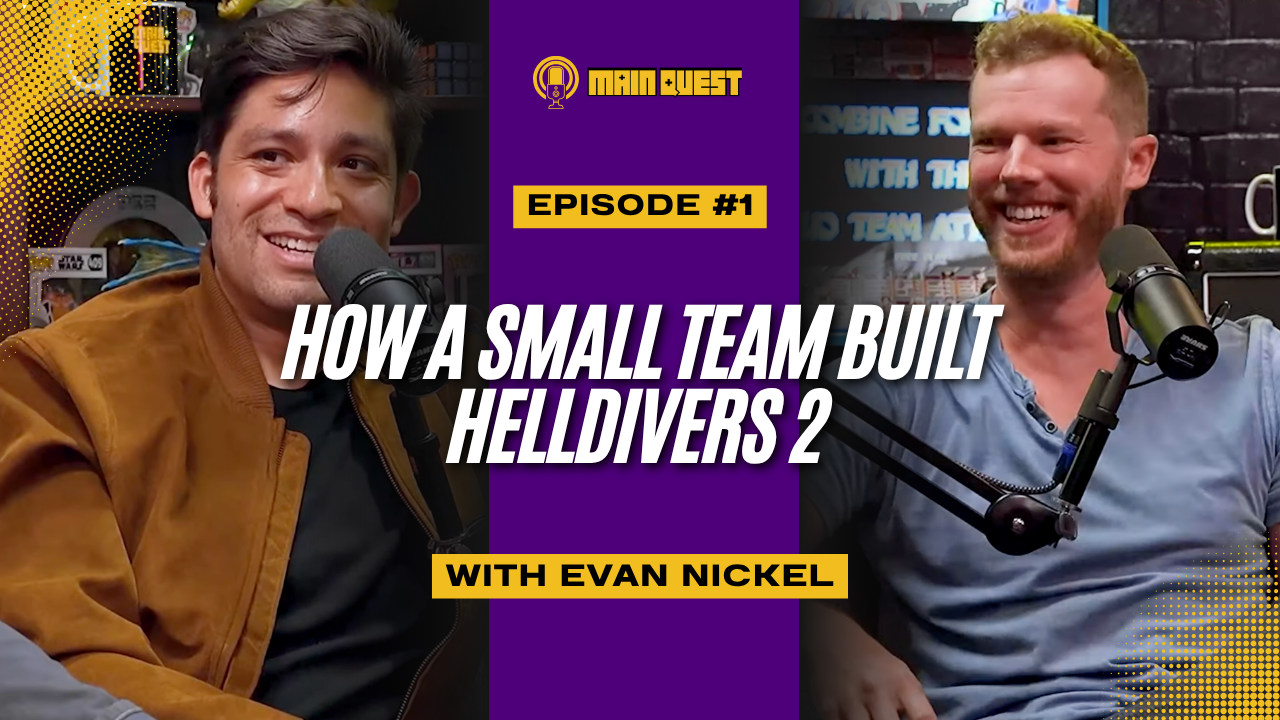
Most people think video games are built like software: timelines, milestones, clean execution. Talking to Evan Nickel about Helldivers 2 makes it clear that’s not even close to the truth. If anything, great games are messy, iterative, and deeply human. They’re less about process and more about vision, taste, and a team that’s willing to fight for both.
That starts with people who don’t fit neatly into one box. Nickel didn’t come up as the best engineer or the best artist in the room. Instead, he carved out a lane in between. He understood just enough of both worlds to connect them, and more importantly, he understood how to work with people. That combination is what led him into production, a role that, despite the reputation, has very little to do with spreadsheets and everything to do with making sure the right things actually get built.
Because here’s the reality: building a game like Helldivers 2 isn’t about executing a plan. It’s about discovering the game as you go. When Nickel joined Arrowhead, the team had a strong instinct for what they wanted, but not a fully defined blueprint. What followed was years of iteration. Systems were built, tested, broken, rebuilt, and sometimes thrown out entirely. Small changes had massive ripple effects. Adjusting something as simple as enemy behavior could swing the experience from empty to overwhelming. There was no shortcut through that. The only way forward was to keep playing, keep tweaking, and keep chasing the version that “felt right.”
That’s because Helldivers 2 isn’t driven by scripted moments. It’s driven by systems. The goal wasn’t to carefully design every player experience, but to create a world where interesting things happen naturally. That philosophy sounds great on paper, but in practice it’s incredibly difficult. You’re not just building features. You’re building interactions between features, and then trying to control chaos without killing it. It’s a constant balancing act between unpredictability and consistency.
Underneath all of it is a very clear point of view about what the game should feel like. Helldivers 2 isn’t about being a hero. It’s about being expendable. You’re not the main character, you’re cannon fodder with just enough firepower to be dangerous. Friendly fire isn’t a bug, it’s the point. Running out of ammo, calling in the wrong stratagem, accidentally wiping your team—those moments aren’t mistakes in design, they are the design. The game works because it commits fully to that fantasy and builds everything around it.
That level of commitment doesn’t happen without tension. At different points, there were pushes to make the game more accessible, faster, more familiar. That’s a natural instinct, especially at scale. But the team held the line. They understood something that a lot of projects lose along the way: if you smooth out all the edges, you risk sanding down the entire identity. Or as they framed it internally, a game for everyone is often a game for no one.
What makes Helldivers 2 stand out isn’t just that it’s fun. It’s that it feels intentional. Every system, every mechanic, every moment of chaos points back to a clear vision. And getting there wasn’t clean or efficient. It was slow, difficult, and full of hard decisions. But that’s the tradeoff. You can ship something that works, or you can keep pushing until it’s great. Arrowhead chose the latter, and you can feel that in every drop pod that lands and every mission that goes sideways.
If there’s a takeaway here, it’s this: great games aren’t assembled, they’re discovered. And the teams that make them work aren’t the ones with the perfect process. They’re the ones with the clarity and conviction to keep going until it clicks.